Afaf Zurayk
-
Scope
/ BRANDS
Brand Strategy, Visual Identity Systems, Typography, Messaging Frameworks, and Print & Packaging.
/ INTERFACESWebsite Design & Implementation, UX/UI Design, and Information Architecture.
-
Client
The Living Archive is the latest and most expansive chapter of our twelve year collaboration with artist Afaf Zurayk. It brings together the many parts of her practice—painting, drawing, poetry, prose, exhibitions, publications, and critical writing—and gives them a place to exist in relation to one another.
It is an archive, but it is not simply a collection of files or a catalogue of finished works. It is a living environment: a place to look, read, wander, make connections, and return to the work over time.
The traditional archive tends to be organized around preservation. Things are catalogued, dated, numbered, and put in their proper place. That information is important, particularly for an artist whose work spans decades, but it does not necessarily describe how people actually experience art.
Afaf’s work has always moved between painting and language. A painting can lead to a poem; a poem can change the way a painting is seen; an exhibition can bring a group of works into a new relationship. The Living Archive was designed around those connections.
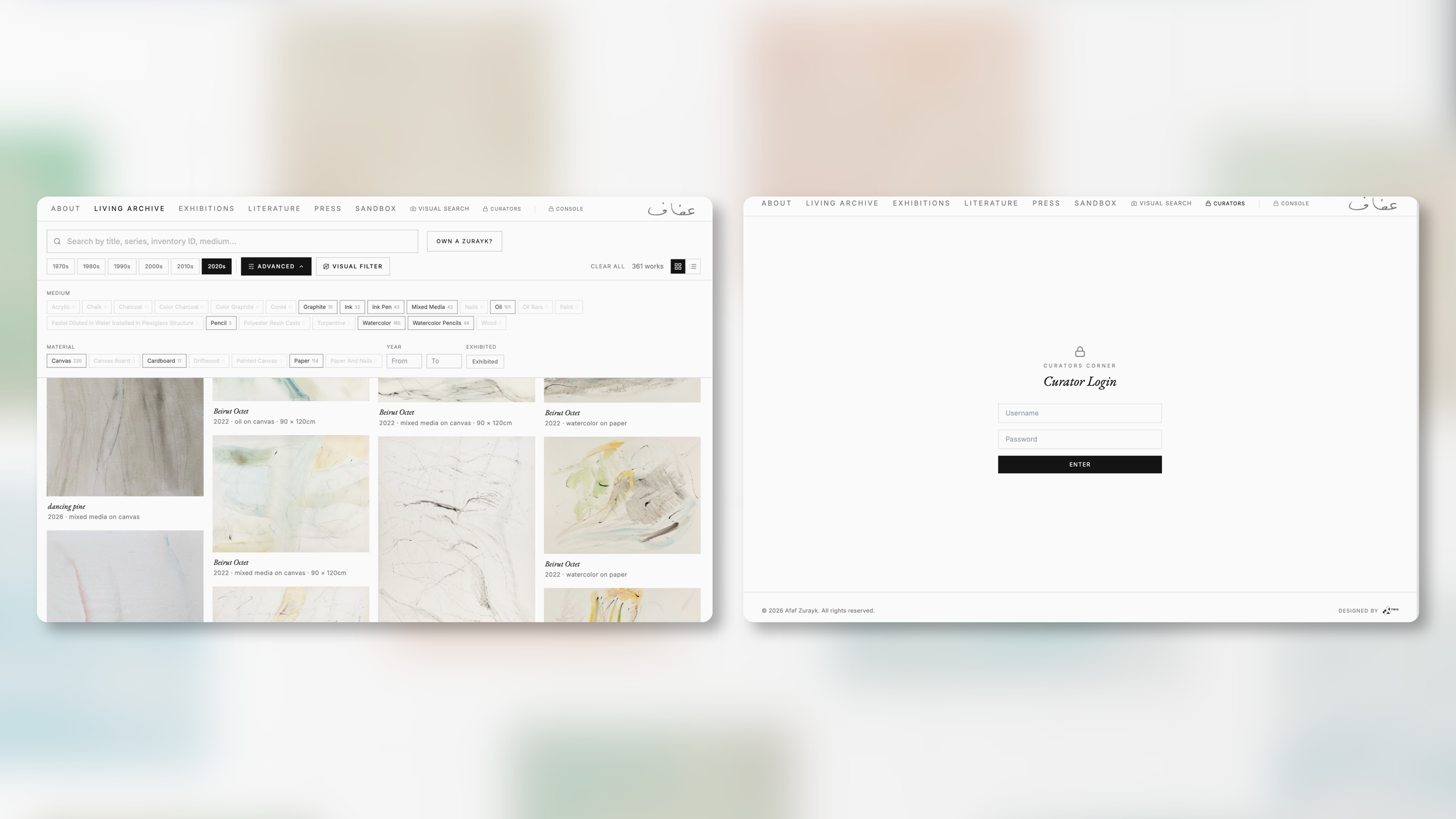
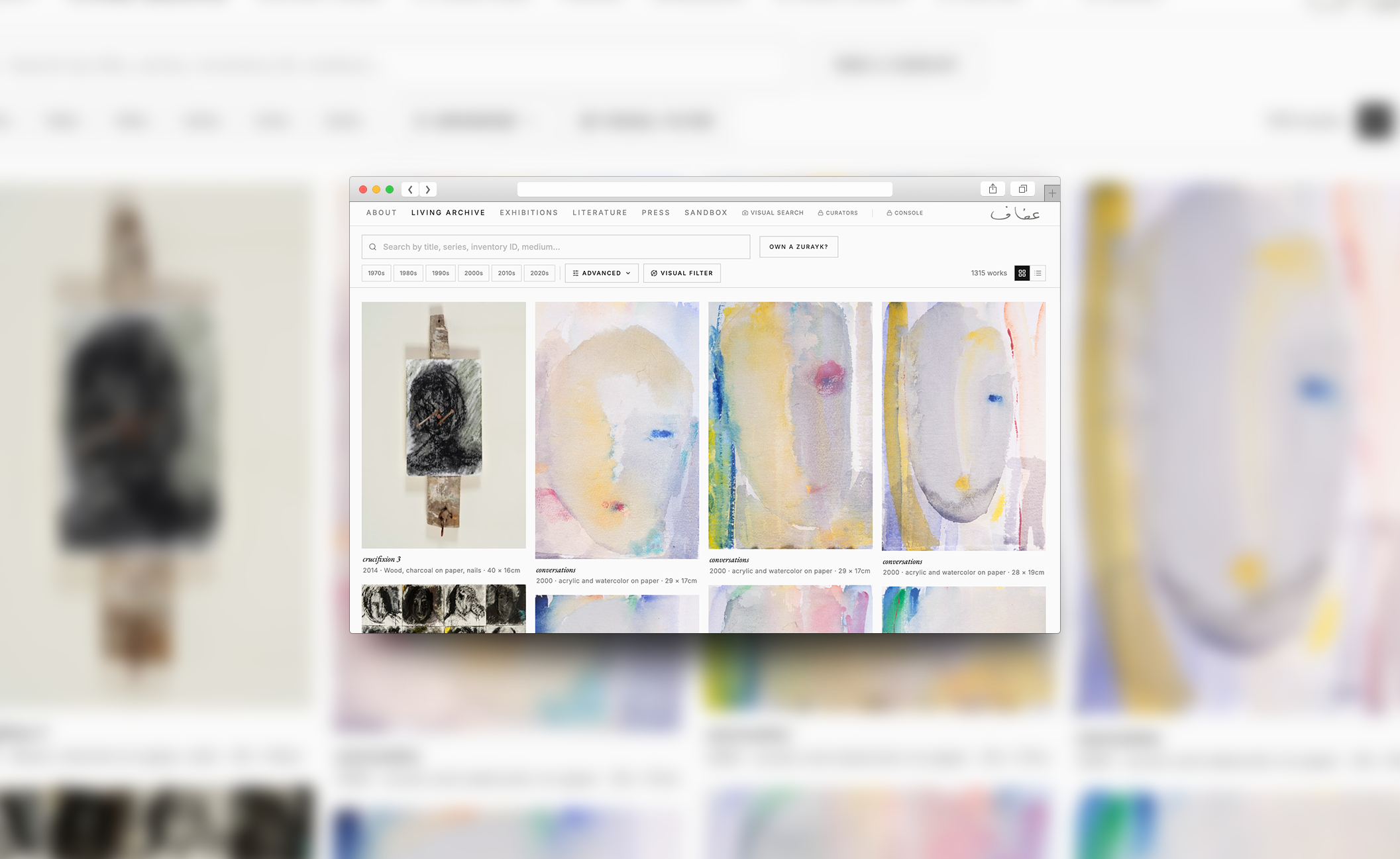
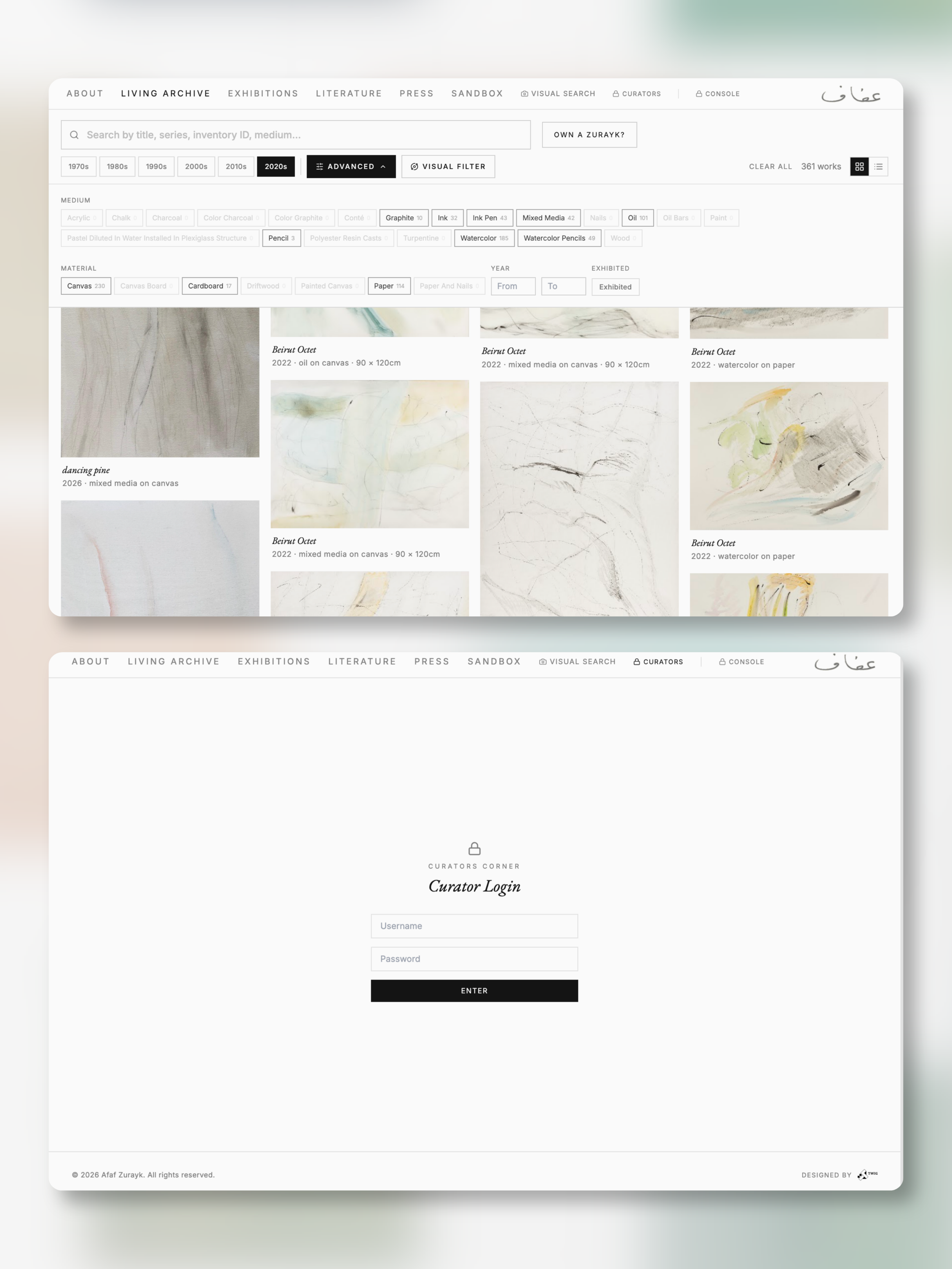
Visitors can browse the complete body of work as a collection, moving through it by series, medium, year, or concept. They can also follow less linear paths; moving from a work to an exhibition, from an exhibition to an essay, from an essay back to another work. The structure allows the archive to be read in multiple ways rather than prescribing one route through it.
The result is closer to wandering through a studio, library, or exhibition than searching a database.
The Work, in Context
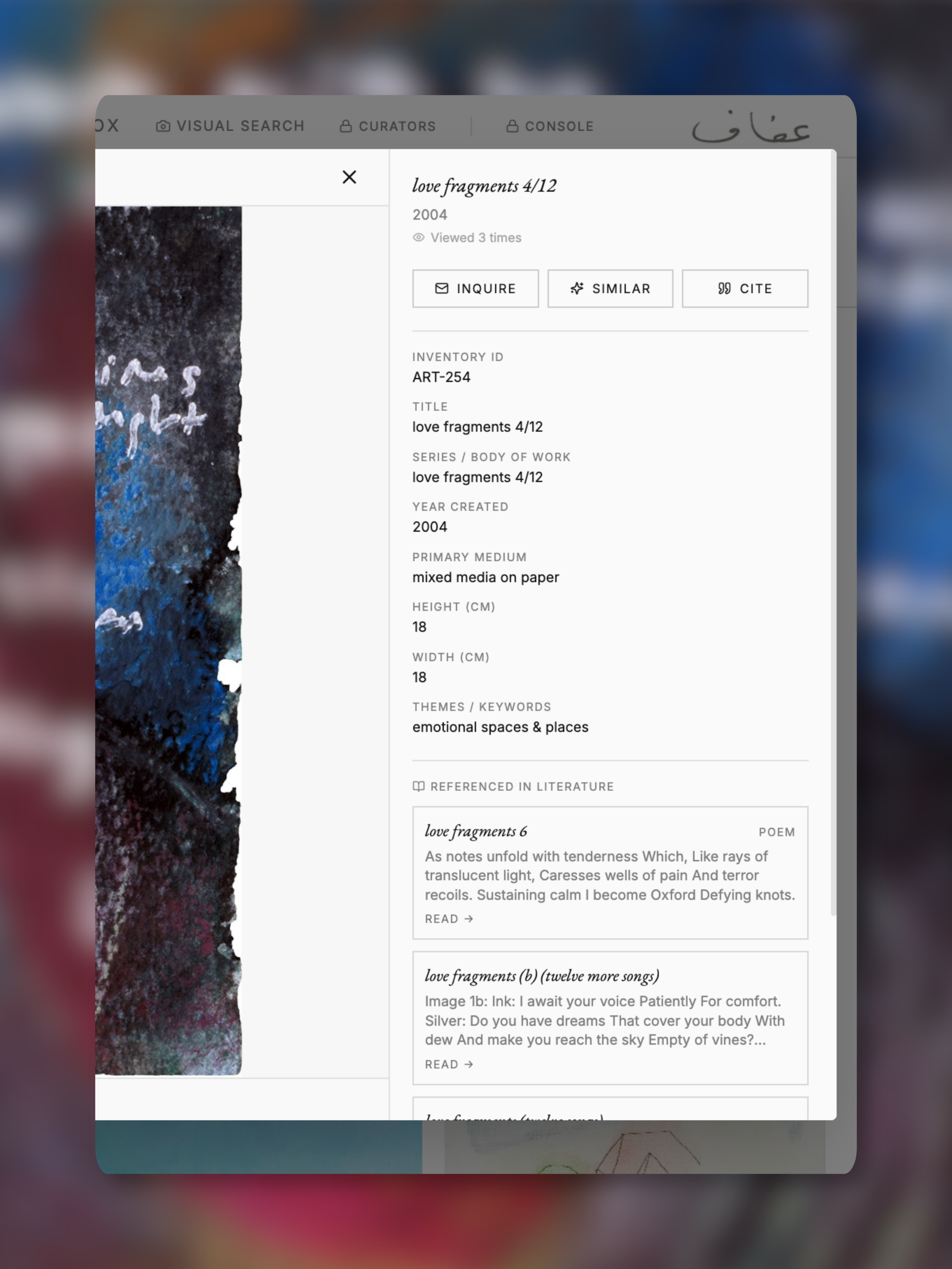
At the center of the archive is the work itself. Each painting and drawing has its own space, with the information that surrounds it: dimensions, medium, date, provenance, exhibition history, and other details that become increasingly meaningful as a body of work grows.
But the individual work is never isolated.
Past exhibitions can be revisited in their entirety, with installation photography, curatorial texts, videos, biographies, and the works that were included. Literature sits alongside the visual archive, bringing together Afaf’s own poems, prose, and statements with essays and criticism written about her work.
One of the things we wanted to avoid was making the archive feel overly institutional. There is a practical side to the project, of course. A body of work spanning decades requires accurate records, careful organization, and a system capable of keeping everything connected. But the experience of using the archive should not feel like working through a filing cabinet. Thus, the interface is intentionally open and spacious. Images and text move within a flexible grid, allowing the experience to shift depending on what is being viewed. The visitor can move quickly through a large number of works or slow down and spend time with a single one.
There is also an element of play. In the Sandbox, works can be pulled together onto a virtual wall, resized, moved around, and annotated. A visitor can make their own temporary relationships between works and save those arrangements for later. It is a simple gesture, but an important one: the archive does not only ask you to look at Afaf’s work. It gives you room to look at it your own way.
The Living Archive was also designed with the understanding that an artist’s archive is never really finished. The system behind the archive allows those changes to be incorporated over time rather than requiring the entire experience to be rebuilt. There are quieter parts of the archive that support this ongoing process. Curators can be given private spaces to work with the collection. Artwork owners can submit works for consideration. Images can be compared against the existing catalogue to help identify works, while the gallery can review and confirm the information before anything becomes part of the public archive.
These tools are largely invisible to the person visiting the site, which is exactly the point. They allow the public-facing archive to remain fluid while the underlying record stays carefully maintained.
A Record of a Life in Work
After 48 years of prolific production work, the Living Archive offers a way to see Afaf’s practice as a whole. It asks questions that are central to the life of an artist. What happens to a painting after an exhibition closes? Where does a poem live once the book it appeared in is out of print? How does an exhibition remain present after the room has disappeared? How can documentation, criticism, and memory surround the work without defining it?
The Living Archive gives these things a place to coexist. Most importantly, the archive does not seek to bring Afaf’s work to a conclusion. Her practice remains open, and so does the archive. New work can enter, old work can be seen again, and connections that may have remained invisible can emerge over time.